
If your place in Whitby, Ajax, Oshawa, or Toronto already looks like a box factory and your move date is getting too close for comfort, you’re in the same spot a lot of people hit. Packing always seems manageable at first. Then the tape guns come out, the dishes are still in the cupboards, and nobody’s quite sure what to do with the lamp shades, framed art, cords, pantry items, or the junk that somehow multiplied in the garage.
That’s why people start looking up packers for moving. Not because they can’t put items in boxes, but because they want the job done properly, on time, and without turning the last week before a move into a full-time second job.
In the GTA and Durham Region, packing has a local layer that a lot of generic moving advice misses. Condo elevators have rules. Winter weather changes how quickly boxes need to move. Older homes in Oshawa and newer condos in Toronto create totally different packing plans. Add in hidden quote issues and Ontario rules around hazardous items, and it’s easy to see why packing is one of the hardest parts of moving to get right.
The Real Cost of DIY Packing Stress Time and Broken Items
A lot of DIY moves start the same way. One weekend is set aside for packing. A few boxes get built. The kitchen is left for later because it looks annoying. The closet is “easy,” until it isn’t. Then moving week arrives, and the living room in Ajax or Pickering is full of half-packed cartons, open drawers, and random piles marked “sort later.”

What catches people off guard isn’t just the work. It’s the mental drag. You still have to deal with address changes, utility transfers, kids’ schedules, condo booking windows, cleaning, and the long list of things that only show up in the final days. Packing sits on top of all of it.
What usually goes wrong
DIY packing tends to break down in a few predictable spots:
- Kitchens stall out: Glassware, plates, pantry goods, and small appliances take longer than people expect.
- Boxes get overfilled: Books, canned food, and tools end up in cartons that are miserable to carry.
- Labels stay vague: “Bedroom stuff” sounds fine until you’re hunting for chargers and medication at 10 p.m.
- Fragile items get improvised: Towels and old blankets work for some things, but not for all things.
- The final day turns messy: Loose items, open-top bins, and “just toss it in the car” decisions create damage risk.
Practical rule: The packing job isn’t finished when the box is shut. It’s finished when the box can be carried safely, stacked properly, and found easily at the other end.
Why stress becomes a real cost
Even when people save money upfront, they often pay in other ways. They lose evenings, burn out before moving day, and arrive at the new place already exhausted. That’s especially rough on winter moves around Oshawa or Bowmanville, where delays and slippery conditions make a disorganised load much harder to manage.
A good packing plan removes that pile-up. If you want helpful prep advice before making any decisions, these packing tips for moving are a solid place to start.
Professional packing isn’t about making a simple task look fancy. It’s about controlling chaos before it spreads through the whole move.
What Professional Packers Actually Do The Systematic Approach
Professional packers for moving don’t walk in and start stuffing boxes. The job works because the process is systematic. Every room, item type, and loading sequence matters.
The best crews use a room-by-room packing protocol. In Ontario local moves, that approach helps teams finish 25-40% faster than DIY packing, and trained crews average 7-8 hours to fully pack a 3-4 bedroom home, while also cutting damage claims by up to 30% according to MoveAdvisor’s overview of professional packing services.
The job starts before the first box is taped
A proper pack begins with a quick assessment:
- What rooms are staying active until the last day
- Which items are fragile or awkward
- What needs special cartons
- What should not be packed at all
- How the packed boxes will flow to the truck
That last point gets ignored in DIY moves. A box isn’t packed in isolation. It’s packed for carrying, stacking, transport, unloading, and unpacking.
Room by room beats random packing every time
Crews work best when they keep categories clean.
Kitchen packing
This is usually the hardest room. Plates need proper wrap. Glasses need separation. Pantry items need weight control. Small appliances need cord management and clean boxing so they don’t damage other contents.
Bedrooms and closets
Wardrobe boxes help with hanging clothes. Linens and soft goods can cushion select items, but they shouldn’t become a catch-all substitute for proper packing paper. Drawers often need to be emptied depending on weight and furniture design.
Living rooms and family rooms
Electronics, lamps, décor, framed pictures, and mixed shelving contents need careful sorting. Vague labels create headaches later.
If the box says “miscellaneous,” expect trouble at the new place.
Home offices
Cords, monitors, files, and small peripherals create disorder fast. A disciplined labelling system saves hours later, especially if you’re trying to get back to work quickly after the move.
Materials matter more than most people think
Professional crews choose cartons based on the contents, not based on whatever boxes happened to be available. That includes stronger boxes for heavy items, dividers for breakables, and extra protection for surfaces that scratch easily.
A good system also uses clear, consistent labels. Colour-coded room marking, detailed box notes, and inventory checks help keep the job organised from the first packed box to the final unload. For anyone comparing local options, this guide to packing companies for moving can help clarify what a proper service should include.
Why the system saves money
Packing faster is useful. Correct packing delivers the most value.
When the crew follows a repeatable process, you usually get:
- Less rehandling: Boxes don’t need to be reopened and repacked.
- Cleaner loading: Similar boxes stack together and travel better.
- Fewer missing items: Labels and inventories reduce confusion.
- Better unpacking flow: Priority rooms can be identified right away.
The difference is easy to see on moves from larger homes in Oshawa or Whitby into tighter Toronto condos. A random packing job creates delays at every stage. A systematic one keeps the entire move under control.
Choosing Your Service Full Partial and Specialty Packing
Not everyone needs the same level of help. Some households want the whole home packed from top to bottom. Others only need support in the rooms most likely to cause problems. The right choice depends on your timeline, budget, and what kind of move you’re doing.
Full packing for people who need the entire job off their plate
Full packing means the crew handles nearly everything in the home except the items you’ve set aside as personal essentials or non-pack items. This option makes sense when time is tight, the home is large, or the move is already complicated.
It’s often the best fit for:
- Busy families: School schedules and work don’t leave much packing time.
- Seniors downsizing: The physical effort and decision fatigue add up quickly.
- Last-minute moves: There isn’t enough room for trial and error.
- Office or mixed-use moves: Delays affect more than convenience.
A full pack also works well when the move includes junk removal, furniture disassembly, and a fixed moving date that can’t slide.
Partial packing for the rooms that cause the most trouble
Partial packing is the most practical choice for a lot of local moves. You handle clothing, books, décor, and simple household goods. The crew handles the difficult areas.
That usually means:
- Kitchen items
- Fragile glassware and dishes
- Art and mirrors
- Electronics
- Home office equipment
- Storage rooms with mixed contents
This option works well for a family in Ajax or Courtice that wants to save on labour but doesn’t want to gamble on the hardest parts of the move.
A smart partial pack focuses on the rooms where breakage, delays, and frustration are most likely.
Specialty packing for high-risk items
Some items need more than ordinary boxes and wrap. They need stabilisation, custom support, and tighter handling rules.
For Ontario condo moves, elevator-friendly packing specifications call for custom crates with maximum 50-75 lb box weights and foam-secured fragile item stabilisation. Expert protocols also show that secure fastening with dual-layer padding reduces transit damage by 45% for specialty items, according to Clancy’s guide to professional packing expectations.
That matters in Toronto high-rises, where hallways are tighter, elevator bookings are strict, and overbuilt boxes can slow down the whole move.
Specialty packing is worth considering for
| Item type | Why it needs special handling | Typical packing approach |
|---|---|---|
| Artwork and mirrors | Surface damage and corner impact | Edge protection, wrap, custom carton or crate |
| Electronics | Sensitive parts and awkward shapes | Foam support, original boxes if available, secure compartment packing |
| Glassware and serving pieces | Vibration and crush risk | Dividers, layered wrap, weight-controlled cartons |
| Collectibles and heirlooms | Hard to replace and often fragile | Individual wrap, cushioning, separate inventory note |
| Condo move fragile items | Elevator and corridor handling | Lighter boxes, stabilised packing, cleaner stacking |
If you’re comparing options, this page on moving companies with packing services helps show how bundled support can make the whole move smoother.
How to choose the right level of service
If you’re unsure, use a simple filter.
Choose full packing if your move feels too big to manage without sacrificing sleep, work time, or sanity.
Choose partial packing if most of your home is manageable but a few rooms clearly aren’t.
Choose specialty packing if the move includes items you can’t afford to replace, or if condo access rules leave no room for poorly packed cartons.
What doesn’t work is paying for too little help on a move that already has enough complexity. That usually leads to a split system where half the house is well packed and the other half is rushed. Those are the moves that create loading delays and messy first nights in the new place.
The Cost of Hiring Packers in the Durham Region and GTA
Packing prices matter. People aren’t just asking whether professional packing is useful. They want to know whether it’s worth paying for, and whether the quote is going to hold.

In this region, pricing gets messy when estimates are vague. According to Associated Packers’ summary of hidden moving charges, 62% of moving issues in Ontario Consumer Protection Branch complaints involved surprise fees for stairs, elevators, or parking. The same source notes that Durham Region intra-provincial movers face average packer costs of $1,800, and 40% exceed quotes because of unlisted fees.
What a packing quote should actually cover
A useful quote should spell out the basics clearly:
- Labour: How many packers are included and how the time is billed
- Supplies: Whether boxes and specialty materials are included
- Access issues: Condo elevators, long carries, stairs, and parking conditions
- Scope: Full pack, partial pack, or selected fragile items only
- Day-of changes: What happens if the scope grows after booking
If those points are fuzzy, the final invoice can drift fast.
Where quotes go off track
The biggest pricing problems usually don’t come from the packing itself. They come from details that weren’t discussed early enough.
Condo access
Toronto, North York, and parts of Scarborough often involve service elevators, loading dock windows, and booking restrictions. If the company hasn’t planned for that, you can lose time and money.
Stairs and walk-ups
Older buildings in Oshawa, Pickering, and parts of downtown Toronto can add labour strain quickly. A quote that ignores access difficulty isn’t a real quote.
Parking and distance to the unit
A truck parked far from the entrance changes labour time. So does a long interior carry through a building.
Watch for this: If the estimate looks cheap but barely mentions access, materials, or building logistics, it may not stay cheap.
How to think about cost the right way
The cheapest number on paper isn’t always the lowest overall cost. Poor packing creates breakage, delays, missing items, and harder unpacking. It also burns your own time. If you’re taking time off work, coordinating family schedules, or trying to move during a weather window, that has value.
For broader local pricing context, this honest GTA and Durham moving cost guide gives a useful look at how transparent estimates should be structured.
What good value looks like
A fair packing service should feel predictable. You should understand what’s included, what isn’t, and how extra requests are handled. Good value usually includes:
- Clear scope
- Proper materials
- Real communication
- No mystery add-ons
- Packing that saves time on moving day, not just before it
That’s where local companies stand apart. In the Durham Region and GTA, access conditions change from one postal code to the next. A practical quote has to reflect the actual building, not just the rough size of the home.
DIY Packing vs Hiring Professionals A Head-to-Head Comparison
Choosing between DIY and professional packing isn’t only about budget. It’s a trade-off between control and convenience, and between upfront savings and downstream headaches.
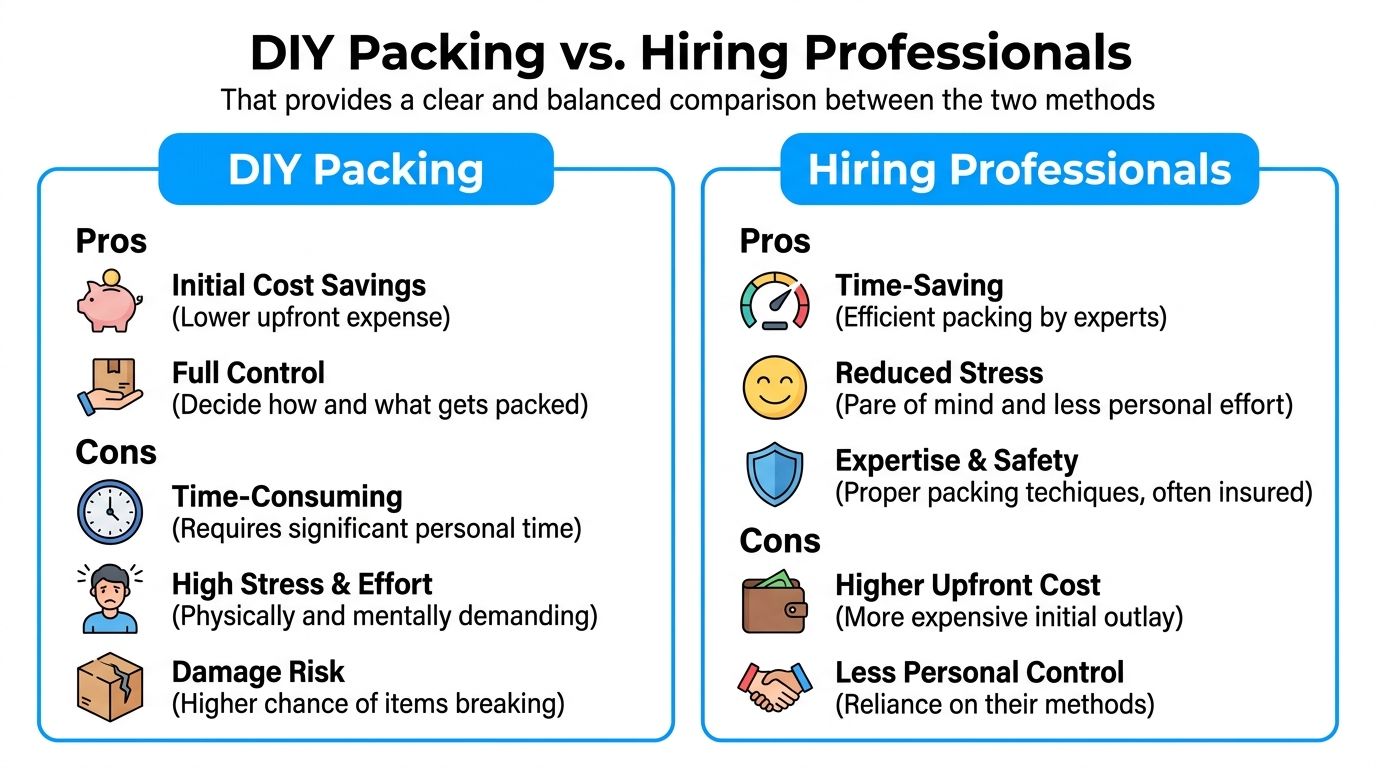
DIY vs Professional Packers A Quick Comparison
| Factor | DIY Packing | Professional Packers |
|---|---|---|
| Cost | Lower upfront spend | Higher upfront spend |
| Time | Takes evenings, weekends, and last-minute hours | Faster and more organised |
| Physical effort | Heavy lifting, bending, sorting, carrying | Much less personal strain |
| Damage risk | Higher if materials or methods are inconsistent | Lower when items are packed properly |
| Stress level | Often rises as move day gets closer | Usually easier to manage |
| Control | Full control over every box | Shared control with a system |
Where DIY still makes sense
DIY can work well if your move is small, simple, and not rushed. A one-bedroom apartment with minimal fragile items is a different job from a full family home. If you like sorting your own things and have enough lead time, self-packing can be perfectly reasonable.
It also works for people who want a hybrid move. They pack clothing, linens, toys, and books, then leave the kitchen, art, and electronics to professionals.
Where professional packing wins clearly
There are moves where DIY looks cheaper at first but becomes expensive in effort and risk.
Those include:
- Winter moves in Oshawa or Whitby: Snow, wet surfaces, and cold loading conditions reward speed and organisation.
- Toronto condo moves: Elevator bookings punish delays.
- Family homes with a lot of breakables: Kitchens, décor, and storage rooms add up.
- Senior moves: Fatigue and safety matter.
- Office relocations: Downtime hurts operations.
Hiring packers makes the most sense when the move has consequences beyond inconvenience.
The deciding question
Ask yourself one thing. If you packed the entire home yourself, would the move be more organised, or would you be more tired?
That answer usually tells people what they need to know. If the honest answer is “more tired,” then professional help isn’t an indulgence. It’s a way to protect the move from avoidable mistakes.
DIY gives you maximum control. Professional packing gives you structure, speed, and less wear on your body. For many local moves, especially when access is tight or the schedule is fixed, the second option is the safer bet.
Your Pre-Packing Checklist What to Do Before Packers Arrive
A smooth packing day starts before the crew pulls up. Good preparation doesn’t mean doing the hard part yourself. It means clearing obstacles so the work can move quickly and cleanly.
Start by removing what shouldn’t be moving at all
The easiest box to carry is the one you never pack.
Before packing day, sort out:
- Items to donate
- Broken furniture
- Old electronics you won’t reuse
- Worn-out décor
- Garage clutter
- Pantry items you know you won’t take
If you need a fast reset before moving week, this guide on how to lighten your load before the moving truck arrives is a practical starting point.
Build one do-not-pack zone
Every home needs one clearly marked area for personal essentials and non-pack items. Don’t leave this to memory.
Set aside:
- Wallets, passports, and ID
- Medications
- Keys
- Phones and chargers
- Laptops and personal paperwork
- Jewellery
- Daily toiletries
- Kids’ must-have items
- Pet supplies for the first day
A sealed bedroom, a labelled counter area, or one designated closet works well. The key is making it obvious.
Know what Ontario packers can’t take
This is one of the biggest reasons moves get delayed.
In Ontario, 28% of GTA residential moves involve hazardous household goods, but only 12% of consumers are aware of transport restrictions, which contributes to 15% of moves facing delays or fines, according to Lawrence Moves’ article on identifying items you do not wish to have packed.
That means you should separate restricted items before the crew arrives.
Common examples to pull out in advance
- Paints and solvents
- Cleaning chemicals
- Aerosols
- Propane tanks
- Other flammable or hazardous household materials
If these are still mixed into a basement shelf, garage cabinet, or under-sink storage area, the pack can stop while everyone sorts it out.
Keep hazardous items visible and separate. Don’t leave them buried beside ordinary household goods.
Handle building logistics early
For condo and apartment moves, especially in Toronto and parts of Mississauga or Markham, logistics can slow things down more than the packing itself.
Check these in advance:
- Elevator booking window
- Loading area rules
- Parking access
- Certificate or paperwork requirements
- Time restrictions for move-ins and move-outs
If you wait until the day before, you may end up with a perfect packing job and nowhere to move the boxes on schedule.
Make access easy inside the home
A few simple steps help the crew move faster:
- Empty pathways
- Keep pets secured
- Unplug electronics you’re ready to pack
- Identify items going to storage or another address
- Mark any furniture or cartons that are staying behind
This doesn’t sound dramatic, but it saves confusion. A clear home packs better than a crowded one.
The On The Move Difference Why Choose Our Packing Services
When people hire packing help, they’re not only buying boxes and labour. They’re buying trust. They want to know the crew will show up, handle the home properly, and keep the move straightforward from start to finish.
That’s where On The Move Moving & Junk Removal stands out for Durham Region and GTA moves.
Built for local moves, not generic advice
Drawing on over 15 years of experience, the team understands the complexities of moving across Oshawa, Whitby, Ajax, Pickering, Toronto, Courtice, and surrounding communities. That includes condo timing, suburban family moves, seniors downsizing, office relocations, and the kind of weather and access issues that change the whole day if the crew isn’t prepared.
What customers actually benefit from
- Fully insured and bonded: Peace of mind matters when someone is packing your kitchen, electronics, and fragile items.
- Affordable rates: The goal is practical value, not inflated full-service pricing.
- Free supplies: That helps reduce one of the most annoying line items in a move.
- We pay the tax: It keeps budgeting simpler.
- No truck or fuel fees: Fewer surprise charges. Cleaner quotes.
- Packing and junk removal together: Useful when you want to clear unwanted items before the first box is taped.
Easy ways to keep planning
If you’re still comparing options, these pages are worth a look:
- packing and unpacking services
- professional movers in Whitby
Why this matters on moving week
The best packing service isn’t the one that sounds impressive online. It’s the one that keeps your move calm. Clear quoting, proper materials, local experience, and crews that know how to work in real GTA and Durham buildings make a big difference when the clock is running.
If you want a move with fewer loose ends, fewer surprises, and less stress on your family, choosing the right packing team is one of the best decisions you can make.
Your Stress-Free Move Starts Here FAQs and Next Steps
Packing is where a lot of moves start going sideways. When it’s organised properly, the rest of the job gets easier. Boxes are labelled, fragile items are protected, access plans are accounted for, and moving day doesn’t begin with panic.
FAQs
Do I need to be home while packers are working
It helps to be available at the start so you can point out priority items, do-not-pack items, and any special instructions. After that, many people stay nearby or check in as needed.
Should I pack anything myself first
Yes. Personal documents, medications, valuables, and daily essentials should stay with you. It also helps to set aside anything that’s being donated, discarded, or handled separately.
What if I’m moving into an empty place and need help setting up after
That’s often when people realise the move isn’t really over at the front door. Once the boxes arrive, practical setup matters. If you’re planning room by room after the move, this furnishing a new home checklist is a useful resource for getting the basics in place without missing key items.
Is professional packing worth it for local moves
For many local moves, yes. It’s especially helpful when the schedule is tight, the home has many fragile items, or the building has access rules that make delays expensive and stressful.
If you want a cleaner plan and a free quote, call today and get your move booked early. The easier you make packing, the easier the whole move becomes.
Ready for a move that feels organised from day one? On The Move Moving & Junk Removal makes packing, moving, and clearing out unwanted items simple for homeowners, renters, seniors, and businesses across Durham Region and the GTA. Get a free quote, book your move, and let a local team handle the heavy work without the usual surprises.
CTA
On The Move Moving & Junk Removal – Trusted Movers Across Durham Region & the GTA
Local • Long-Distance • Residential • Commercial • Seniors • Junk Removal
Fully Insured • No Truck or Fuel Fees • Free Supplies • 15+ Years Experience
📞 Call or Text: 289-987-2434 🌐 https://onthemove1.ca
📍 Serving up to 250 km from Hampton, including:
Pickering, Ajax, Whitby, Oshawa, Bowmanville, Courtice, Clarington,
Toronto, Scarborough, Markham, Vaughan, Richmond Hill, Mississauga, Brampton and more.
📚 Read Our Moving & Junk Removal Blogs https://onthemove1.ca/blog/
⭐ Read Our Google Reviews https://maps.app.goo.gl/zJW11oWfodw37fFb7