
Moving day budgeting usually starts the same way. You open a few tabs, type in your home size, pick a date, and hope a moving cost calculator gives you a clean number you can trust.
Then the questions start. Does that include stairs? What about elevator bookings in a Toronto condo? Is the truck extra? What happens if your inventory list was too light, or the crew needs more time because the loading area in Whitby is tighter than expected?
That's why a good moving cost calculator ontario search should lead to more than a quick estimate. It should help you understand how movers in Ontario price a job, where budgets go sideways, and how to build a number that's realistic for your home, your building, and your schedule.
Your Guide to Moving Costs in Ontario
Most local moves in Ontario are priced on an hourly model, not a flat mystery number. According to CompareMovers.ca's Ontario moving price data, off-peak May rates for 2 movers range from $113 to $170 per hour, and that rises to $155 to $278 per hour during the busy June 16 to 23 period. That gap is exactly why online calculators can feel inconsistent. Timing changes everything.
For local moves, the basic structure is simple. The bill is built from hourly labour, the time the move takes, and any added fees connected to access, packing, or special handling. If you want a practical starting point for moving costs in Ontario, Ontario moving prices, it helps to look at pricing by season first, then narrow it down by home size and access conditions.
Some people are also coordinating more than a home move. If your relocation includes shipping a vehicle for a military posting, this guide for military car relocation to Hawaii is a useful example of how transport logistics create extra planning layers.
A calculator is most useful when you treat it as a budgeting tool, not a final invoice.
How Moving Cost Calculators Actually Work
A local moving calculator is only as good as the information you feed it. In Ontario, local moves under 80 km are commonly estimated using a version of this formula:
(Hourly Rate × Number of Movers × Hours) + Additional Fees
That sounds simple, but each part changes based on your home, your route, and your move date.
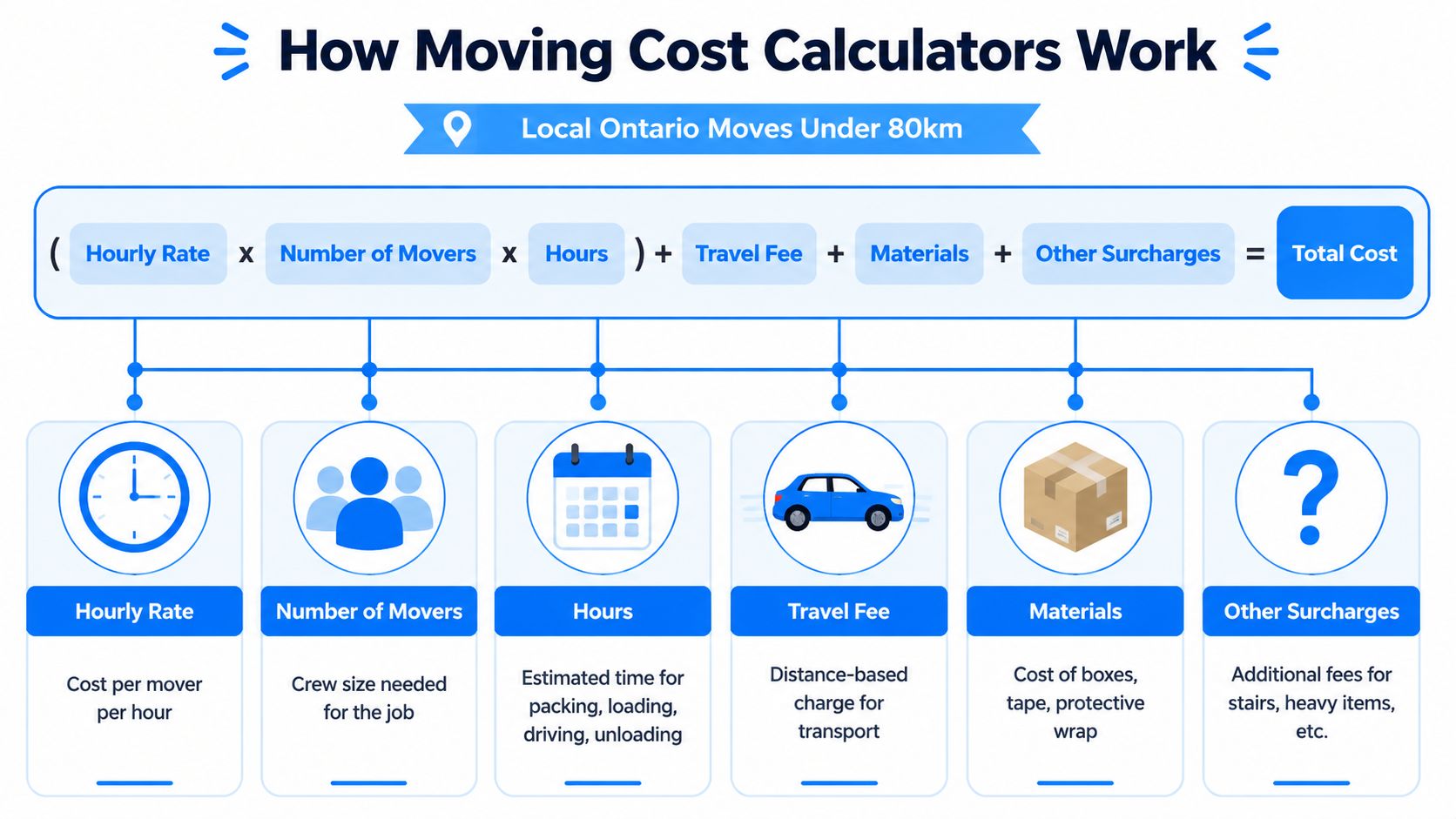
Hourly rate is the first moving piece
The hourly rate usually reflects the crew and the season. A move booked in a quieter period won't price the same way as one booked during the busiest summer rush. Ontario pricing changes sharply when demand spikes, which is why two similar homes can get very different estimates depending on the week they move.
If you are trying to budget storage at the same time as a move, a tool like this secure Woodbury self storage calculator can also help you think through how much space your furniture and boxes may require.
Number of movers changes speed and cost
A Pickering condo with a modest furniture load may only need a small crew. A larger Bowmanville house with multiple bedrooms, heavy dressers, a basement, and outdoor items may need a bigger team.
Many online calculators oversimplify. A smaller crew can look cheaper at first, but if the move takes much longer, the savings disappear. A larger crew can sometimes be the safer and more efficient choice, especially when there are multiple floors or a tight moving window.
Hours depend on access, not just square footage
The “hours” part is where calculators often get shaky. They may estimate from home type alone, but real jobs are shaped by access.
A one-bedroom unit in Toronto might take longer than a suburban two-bedroom if there's:
- Elevator wait time
- Long hallway travel
- Loading dock rules
- Limited parking
- Strict booking windows
In comparison, a simple driveway-to-driveway move in Ajax can be faster because the crew spends less time navigating the building and more time moving boxes and furniture.
Fees are where transparency matters
Many calculators add a general “fees” bucket without explaining it. That's not very helpful. In practice, that part may include packing labour, specialty handling, stairs, access complications, or other services. Some movers also separate truck-related costs. Others bundle them.
Practical rule: If a calculator gives you a number without asking about stairs, elevators, inventory detail, or building access, assume it's only a rough starting point.
That's why the best estimates come from detailed inputs, not quick dropdowns.
The Core Factors That Determine Your Moving Bill
Assumed pricing based only on an address is the most significant error people make. It is not that simple. Two local moves within one city can have very different prices because the actual drivers are volume, distance structure, and crew requirements.

Volume and inventory shape the workload
A sparsely furnished downtown Toronto condo is one thing. A Whitby family home with years of accumulated furniture, storage bins, garage contents, patio pieces, and packed closets is another.
Inventory matters because it affects loading time, truck space, carrying difficulty, and unloading setup. If your list misses key items, the estimate won't match the job. According to Ontario moving pricing analysis from Rentason, 62% of movers report cost overruns, and 40% of disputes are caused by inaccurate inventory. The same source notes that 28% of customers face surprise fees averaging $350.
That's not a calculator problem alone. It's usually an input problem.
Distance is more than kilometres
For local work, “distance” often means more than the drive between addresses. It also includes how the crew gets from truck to door.
A short Oshawa to Courtice move may still become labour-heavy if the pickup location has tight stairs and the destination has a long walk from the legal parking spot. A longer route with easy access can be smoother than a shorter route with bad access on both ends.
Here are the practical access issues that often affect the bill:
- Condo loading procedures
- Street parking limits
- Long driveway or walkway carries
- Tight staircases
- Small elevators
- Shared entrances in apartment buildings
For a more detailed breakdown of the factors that determine your moving expenses, it helps to think in terms of labour conditions, not just postal codes.
Crew size affects both safety and timing
A small apartment often suits a 2-person crew. A larger home, especially one with multiple floors, usually needs more hands to keep the move efficient and reduce handling risk.
People sometimes assume the smallest crew is always the budget option. It often isn't. If the job is physically large or awkward, too few movers can create delays and make the day harder on everyone involved.
The cheapest-looking setup on paper can become the more expensive move if the crew is undersized for the home.
Hidden cost drivers are usually visible in advance
The good news is that many “unexpected” costs are only unexpected because nobody asked the right questions early enough.
A reliable estimate should account for:
- Stairs at either end
- Elevator bookings and timing
- Oversized or fragile items
- Packing help
- Disassembly and reassembly
- Access restrictions on the street or in the building
When those details are discussed upfront, the quote gets much closer to reality.
Beyond the Basics Special Services and Surcharges
Basic calculators are good at broad averages. They're much weaker at handling the things that make real Ontario moves complicated.
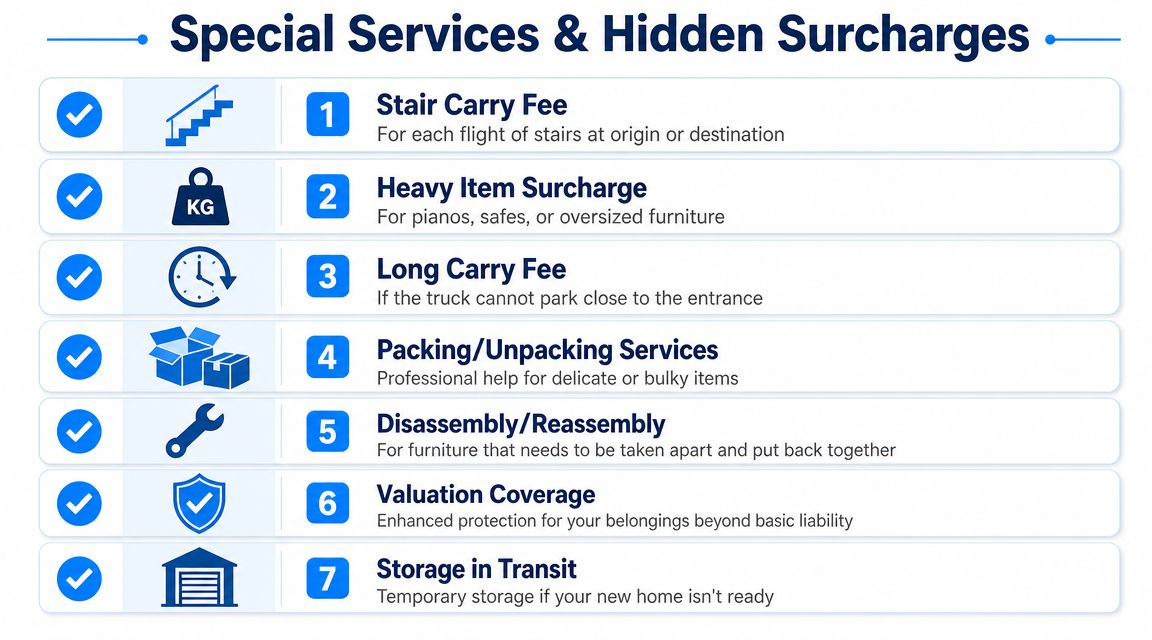
Stairs and elevators
Toronto condo moves are the classic example. You may have an elevator booking, a service entrance rule, a loading dock window, and a wait if another resident overruns their slot.
Ontario data cited by Rentason notes that hidden fees can come from elevator bookings ranging from $100 to $300, and it also warns that GTA-specific access issues regularly catch people off guard. If your calculator never asked about the building, it likely missed a meaningful part of the job.
Long carries and awkward access
Durham Region has its own version of this problem. Not every home lets the truck park close to the entrance. Some properties have long driveways, side access only, or walkways that turn a simple unload into repeated long carries.
The same Ontario pricing source reports that long carries in Durham Region can add 15% to 25% to the final bill when they're not factored in ahead of time. This is one reason quick online calculators often look better than the final invoice.
Packing and unpacking support
Packing is one of the easiest ways to underestimate a move. It adds labour before moving day, but it can also speed up the move itself when everything is boxed, labelled, and ready.
If you need help protecting dishes, artwork, lamps, electronics, or wardrobes, professional packing and unpacking services can simplify the entire move. That same page is also a useful Ontario full-service moving guide if you're comparing partial service against a full-service booking.
Specialty items, storage, and junk removal
Some items take extra planning even when the rest of the move is standard. Pianos, gym equipment, large sectionals, antique cabinets, and oversized office furniture all change the handling plan.
The same goes for moves that involve:
- Temporary storage before possession day
- Furniture that needs disassembly and reassembly
- Appliances moved through narrow spaces
- Items that should be removed instead of transported
A move also gets easier when you separate what's coming with you from what's leaving for good. Junk removal and short-term storage coordination can reduce clutter before the truck ever arrives.
Here's a simple comparison of common local scenarios.
| Move type | What a basic calculator may include | What often gets missed |
|---|---|---|
| Toronto condo move | Home size, date, rough distance | Elevator bookings, dock timing, hallway carry |
| Whitby house move | Bedrooms, estimated crew | Basement contents, garage items, assembly needs |
| Ajax apartment move | Basic hourly estimate | Minimum charges, parking limitations, stairs |
| Durham downsizing move | Inventory total | Junk removal, storage overlap, packing support |
If you want to understand how transparent billing should look, this moving company invoice example is a good reference point. It helps you see whether a quote is detailed enough to spot labour, access fees, and added services before move day.
A quote should tell you what's included and what triggers extra cost. If it doesn't, you're not comparing apples to apples.
Sample Moving Cost Calculations for Durham and the GTA
A Toronto condo move and a Whitby house move can sit in the same "local move" category and still land very different final bills. I see that every week. The condo job may have less furniture, but fixed elevator windows, loading dock limits, and long hallway carries can add labour time fast. The house move often runs longer because of basements, garages, patio sets, and furniture that has to be taken apart and set back up.
That is why sample pricing only works as a budgeting tool, not as a promise. The useful part is seeing which conditions push a move up or down.
Sample 2026 moving costs in the GTA and Durham Region
| Move Scenario | What usually drives the cost | Typical billing approach | Budget expectation |
|---|---|---|---|
| Pickering to Ajax condo move | Elevator booking, loading area access, walking distance from truck, condo rules | Usually billed hourly for labour and truck time, plus any access-related charges | Often starts lower than a house move, but can climb if the building slows the crew down |
| Whitby to Oshawa family move | More furniture, basement and garage contents, appliance handling, disassembly and reassembly | Usually billed hourly with a larger crew and longer job time | Commonly higher than a condo move because volume and handling time are greater |
| Scarborough office relocation | Desk count, filing cabinets, electronics, after-hours scheduling, elevator coordination | Built from a detailed inventory and site review | Best priced through a custom quote, because layout and downtime matter as much as volume |
The table matters most when you match it to your actual situation. A one-bedroom condo with a strict service elevator booking can cost more than expected. A three-bedroom house with clean access and everything packed in advance can stay under budget better than the homeowner expects.
A practical way to read these examples is to ask four questions:
- How much is being moved? Include lockers, garage shelves, patio furniture, and items in storage.
- How easy is truck access? Downtown towers, narrow driveways, and long carries change labour time.
- What has to be handled with extra care? Glass tops, sectionals, treadmills, safes, and office equipment all affect crew planning.
- Which services are separate from the base move? Packing, junk removal, storage coordination, and furniture assembly usually sit outside a basic calculator number.
For more context on average Ontario moving costs, compare your move by home type first, then adjust for access, timing, and the services you need.
Here is the budget mistake I see most often. People compare two estimates based only on home size. The better comparison is condo versus condo, house versus house, and office versus office, with the same access conditions listed clearly. That is how you catch the hidden fees generic calculators miss.
How to Manually Create Your Own Moving Budget
A manual budget helps when the online number feels too clean for the move you are planning. A Toronto condo with a booked elevator, no loading bay, and a long walk from legal parking does not behave like a Whitby house with driveway access. If you want a number you can trust, build the budget around your exact move conditions.

Start with a room by room inventory
Walk through the property with a notepad and count what will go on the truck. Include the storage locker, garage, balcony, basement, and anything tucked into closets or utility rooms. People often price the visible furniture and forget the dozens of smaller items that add packing time, loading time, and truck space.
Keep the list simple but specific. Note:
- Large furniture in each room
- Estimated number of packed boxes
- Fragile items that need extra wrapping
- Oversized or heavy pieces
- Anything that must be disassembled and reassembled
A useful check is the weight-based planning method published by the Canadian Association of Movers. Even for a local Ontario move priced by time instead of weight, that approach helps you avoid undercounting what is really being moved.
Build the budget from labour time, not just square footage
Use a basic working formula:
Hourly crew rate + truck charges + extra service fees + tax
That gives you a better planning number than relying on home size alone. A small condo can run longer than expected if the elevator is shared and the crew keeps losing time in the lobby. A larger suburban house can move more efficiently if the driveway is open, the boxes are ready, and the crew can load in a straight line.
Start with your inventory, then estimate the labour time based on how the crew will move through each property. If access is tight at either end, add buffer time before you compare your budget to a quote.
Budget rule: Price the move you have, not the floorplan you live in.
Add the charges generic calculators often miss
Manual budgeting pays off in these situations. The base move is only part of the bill.
Set aside room in the budget for:
- Stairs or elevator delays
- Long carry from truck to door
- Extra padding for glass, artwork, or delicate furniture
- Assembly and disassembly
- Appliance handling
- Storage stops or split deliveries
- Waiting time for keys, closing, or condo access
- Packing materials if you want the movers to supply them
These costs do not show up evenly across Ontario. A downtown GTA move often runs into building rules and access delays. In Durham Region, the bigger variable is usually volume, garage contents, or multiple stops between homes, storage units, and family pickup locations.
If you're comparing your own notes against visual planning advice, this video is a helpful companion:
Use a scenario check before you lock in the number
Test your draft budget against an actual move scenario. Ask:
- Will the crew lose time getting in or out of either building?
- Are there items that need two movers to handle slowly?
- Does the truck need to park far from the entrance?
- Will anything still need to be packed on moving day?
- Are you paying for any service that is separate from the move itself?
That quick review catches the usual gaps. It also makes quote comparisons much easier, because you are pricing the same scope with each company instead of guessing from a headline rate.
Make smart budget decisions before you request quotes
Good preparation lowers the risk of surprise charges. It also gives the estimator enough detail to quote the move properly.
Do these before you ask for pricing:
- Take photos of elevators, stairwells, and long walkways
- List heavy, fragile, or awkward items clearly
- Separate what is being moved from what is being donated or discarded
- Finish packing before moving day if you are self-packing
- Confirm building rules, loading times, and possession windows
That is the difference between a rough guess and a budget you can use.
Pro Tips to Reduce Your Ontario Moving Costs
Once you understand how pricing works, you can control a surprising amount of the final bill. The goal isn't to cut corners. It's to remove wasted time, wasted labour, and avoidable extras.
Smart ways to keep the budget under control
- Choose a quieter moving date: Summer demand pushes rates up. If your dates are flexible, avoid the busiest windows and ask about weekday availability rather than defaulting to a weekend.
- Declutter before anyone quotes the job: The less you move, the less labour, truck space, and handling time you need. Remove junk, donations, and dead storage items before your inventory is priced.
- Pack with discipline: If you're doing your own packing, finish it properly before moving day. Half-packed homes create delays because the crew ends up waiting while loose items get boxed.
- Organise access in advance: Book the elevator, reserve loading space if possible, and confirm condo rules ahead of time. A well-prepared building move is often far cheaper than a chaotic one.
- Label the priority rooms: Mark boxes by room and note essentials clearly. That speeds unloading and prevents the crew from having to ask where every item belongs.
- Ask for a detailed quote, not just a headline number: A low estimate without line items is often less useful than a slightly higher quote that clearly shows what is included.
- Use included supplies when available: If a mover offers free supplies, that can remove one of the smaller but annoying moving expenses from your list.
- Compare complete value, not just hourly price: A company with no truck or fuel fees and a clear tax policy may be easier on the total budget than a low hourly number with extra charges attached later.
What doesn't usually save money
Some choices feel budget-friendly but often backfire:
- Understating your inventory
- Choosing too small a crew for a large home
- Leaving packing for the last minute
- Ignoring building restrictions
- Booking too late during peak periods
Saving money on a move usually comes from planning better, not from hoping the move will take less time than it actually will.
A professional assessment usually spots the expensive bottlenecks before they happen.
Why a Custom Quote Always Beats a Calculator
A calculator can give you a useful starting range. It cannot see your stair layout, your condo rules, your narrow hallway, your storage locker, or the treadmill in the basement.
That is the actual limit of any moving cost calculator ontario tool. It works on assumptions. A custom quote works on your actual move.
A strong quote should answer practical questions clearly:
- How many movers are recommended
- How long the move is likely to take
- What building or access issues need planning
- Which services are included
- What could change the final price
That level of detail protects your budget better than a quick online estimate. It also makes comparing movers easier, because you're looking at real scope instead of rough averages.
If you're reviewing options, this guide to securing best moving value is a helpful way to think about quote quality, not just quote price.
A custom quote is also where the practical advantages become clear. Fully insured and bonded movers, no truck or fuel fees, free supplies, and a clear tax policy all matter because they affect the true total, not just the first number you see.
Ready for a clear, honest price? Call On The Move today for your free, personalized quote!
Frequently Asked Questions About Moving Costs
Is it cheaper to move on a weekday in Ontario
Usually, yes. Weekdays often give you better scheduling flexibility and less competition for prime moving slots. That matters even more in busy places like Toronto, Whitby, and Oshawa where end-of-month and weekend demand can make booking tighter and pricing less flexible.
If you have any room to choose your date, ask about weekday options first.
Do I need to tip my movers in Ontario
Tipping isn't required. It's a thank-you for excellent service, careful handling, good communication, and a crew that works efficiently under difficult conditions.
Many customers tip when movers handle a challenging day well, especially in bad weather, tight condo bookings, or complicated home layouts. If you're not sure, focus on the quality of service and tip what feels fair within your budget.
How far in advance should I book my move, especially in Toronto
Earlier is better, especially if you're moving in summer or into a condo building with elevator scheduling rules. Toronto moves often involve booking windows, restricted loading areas, and heavier competition for preferred dates.
If you're planning a move in Durham Region or the GTA, don't wait until the last minute if you want the best selection of dates and times.
What's the difference between a binding and non-binding estimate
A binding estimate is generally presented as a committed price for the defined scope of work. A non-binding estimate is an approximation, which means the final cost can change if the move takes longer or includes more than originally listed.
The key issue isn't just the label. It's whether the quote is detailed, transparent, and based on a proper inventory and access review. The clearer the scope, the less chance of an unpleasant billing surprise.
Get Your Free, Accurate Moving Quote Today
If you're planning a move in Oshawa, Whitby, Ajax, Pickering, Toronto, or anywhere across Durham Region and the GTA, the smartest next step is a personalised quote based on your actual inventory and access conditions. A clear quote helps you budget properly, avoid missed fees, and book with confidence.
For local moves, long-distance relocations, condo moves, office moves, packing help, storage coordination, and junk removal, it pays to speak with an experienced Ontario team that keeps pricing straightforward.
Need a moving team that gives you clear pricing, careful service, and real local experience? Get your free quote from On The Move Moving & Junk Removal today.
Get Your Free, Accurate Moving Quote Today
On The Move Moving & Junk Removal – Trusted Movers Across Durham Region & the GTA
Local • Long-Distance • Residential • Commercial • Seniors • Junk Removal
Fully Insured • No Truck or Fuel Fees • Free Supplies • 15+ Years Experience
📞 Call or Text: 289-987-2434 🌐 https://onthemove1.ca
📍 Serving up to 250 km from Hampton, including:
Pickering, Ajax, Whitby, Oshawa, Bowmanville, Courtice, Clarington,
Toronto, Scarborough, Markham, Vaughan, Richmond Hill, Mississauga, Brampton and more.
📚 Read Our Moving & Junk Removal Blogs https://onthemove1.ca/blog/
⭐ Read Our Google Reviews https://maps.app.goo.gl/zJW11oWfodw37fFb7